


Local SEO with AI: What SMBs Need to Know
Introduction: The Local Search Revolution
The digital landscape for small and medium sized businesses has transformed dramatically in recent years. With 46% of all Google searches now having local intent and 76% of mobile “near me” searches resulting in same-day store visits, local SEO has become the cornerstone of small business marketing success.
But here’s the challenge: as more businesses compete for local visibility, standing out requires more sophisticated strategies than ever before. This is where artificial intelligence enters the picture, offering SMBs powerful tools to cut through the noise and connect with nearby customers actively searching for their products and services.
In this guide, we’ll explore how AI is revolutionizing local SEO and provide actionable strategies that small businesses can implement today to boost their “near me” search rankings.
Why Local SEO Matters More Than Ever for Small Businesses
Before diving into AI applications, let’s clarify why local SEO deserves your attention:
- Consumer Behavior Shift: 97% of consumers search online for local businesses, with Google Maps and search becoming the new business directories
- Mobile Dominance: 78% of local mobile searches result in an offline purchase
- Competitive Advantage: Only 44% of small businesses invest adequately in local SEO, creating opportunity for those who do
- Cost Efficiency: Local SEO typically delivers higher ROI than paid advertising for small businesses
For small businesses with physical locations or service areas, appearing in relevant local searches isn’t just beneficial—it’s essential for survival and growth in today’s digital-first economy.

How AI is Transforming Local SEO
Artificial intelligence has introduced game-changing capabilities that make sophisticated local SEO accessible even to businesses with limited resources:
1. Hyper-Relevant Keyword Discovery
Traditional keyword research often misses the nuances of local search intent. AI-powered tools can now:
- Analyze search patterns specific to your geographical area
- Identify seasonal trends unique to your locality
- Discover neighborhood-specific terminologies customers use
- Pinpoint high-conversion local modifiers (beyond just “near me”)
For example, an AI tool might reveal that in your city, customers search for “family dentist downtown” rather than “dentist near me,” allowing you to tailor your content accordingly.
2. Google Business Profile Optimization
Your Google Business Profile (formerly Google My Business) remains the cornerstone of local visibility. AI tools now help by:
- Suggesting optimal business categories based on performance data
- Generating locally optimized business descriptions
- Identifying missing attributes that improve local ranking
- Monitoring competitor profile changes in real time
3. Review Management and Sentiment Analysis
Reviews significantly impact both rankings and customer decisions. AI streamlines this critical area:
- Automatically identifies and flags negative reviews requiring immediate attention
- Analyzes sentiment patterns to uncover business strengths and weaknesses
- Suggests personalized review response templates
- Predicts review trends to help prevent reputation issues
4. Local Content Creation and Optimization
Content remains king in SEO, but local relevance makes it even more powerful:
- AI content tools can generate neighborhood-specific blog topics
- Natural language processing helps optimize existing content for local intent
- Entity recognition technology identifies local landmarks and references to include
- Semantic analysis ensures content matches the language patterns of your local audience

Essential AI-Powered Local SEO Tools for SMBs
While enterprise businesses might invest in comprehensive AI platforms, small businesses can leverage these accessible tools:
1. Local Search Rank Tracking
Tools like BrightLocal and Semrush now incorporate AI to track and analyze your position in local search results:
- Monitor ranking positions for “near me” and location-specific searches
- Track local pack and Maps visibility by neighborhood or zip code
- Analyze ranking fluctuations against local algorithm updates
- Benchmark performance against location-specific competitors
2. AI-Enhanced Listing Management
Consistency across business listings remains crucial for local SEO success:
- Tools like Yext and BirdEye use AI to detect and correct inconsistencies
- Automated distribution ensures NAP (Name, Address, Phone) uniformity
- Smart suggestions improve listing completeness across platforms
- Duplicate detection prevents conflicting information
3. Local Schema Implementation
Schema markup helps search engines understand your business context:
- AI-powered schema generators create location-specific structured data
- Automatic updates ensure schema stays current with business changes
- Implementation validation identifies and corrects errors
- Local business markup enhances rich snippet opportunities
4. Review Generation and Management
Reviews directly impact both rankings and conversion rates:
- AI tools like Podium and GatherUp automate review solicitation
- Smart timing ensures requests go out at optimal moments
- Sentiment analysis categorizes feedback for actionable insights
- Response suggestions maintain brand voice while addressing specific concerns
Implementation Strategy: A 5-Step Approach
Small businesses can follow this framework to integrate AI into their local SEO efforts:
Step 1: Baseline Assessment
Begin by establishing where you currently stand:
- Audit your existing local search visibility
- Identify current ranking positions for key local terms
- Assess Google Business Profile completeness and performance
- Evaluate review quantity, quality, and sentiment
- Check citation consistency across major platforms
Step 2: AI-Powered Competitive Analysis
Understand your local competition:
- Use AI tools to identify who consistently ranks in your local pack
- Analyze their content strategy and keyword focus
- Evaluate their review profile and management approach
- Identify gaps and opportunities their strategy reveals
Step 3: Local Keyword and Content Strategy
Develop your local SEO foundation:
- Deploy AI tools to identify high-value local search terms
- Create location pages optimized for neighborhood-specific searches
- Develop content addressing local customer questions and needs
- Implement local schema markup across your website
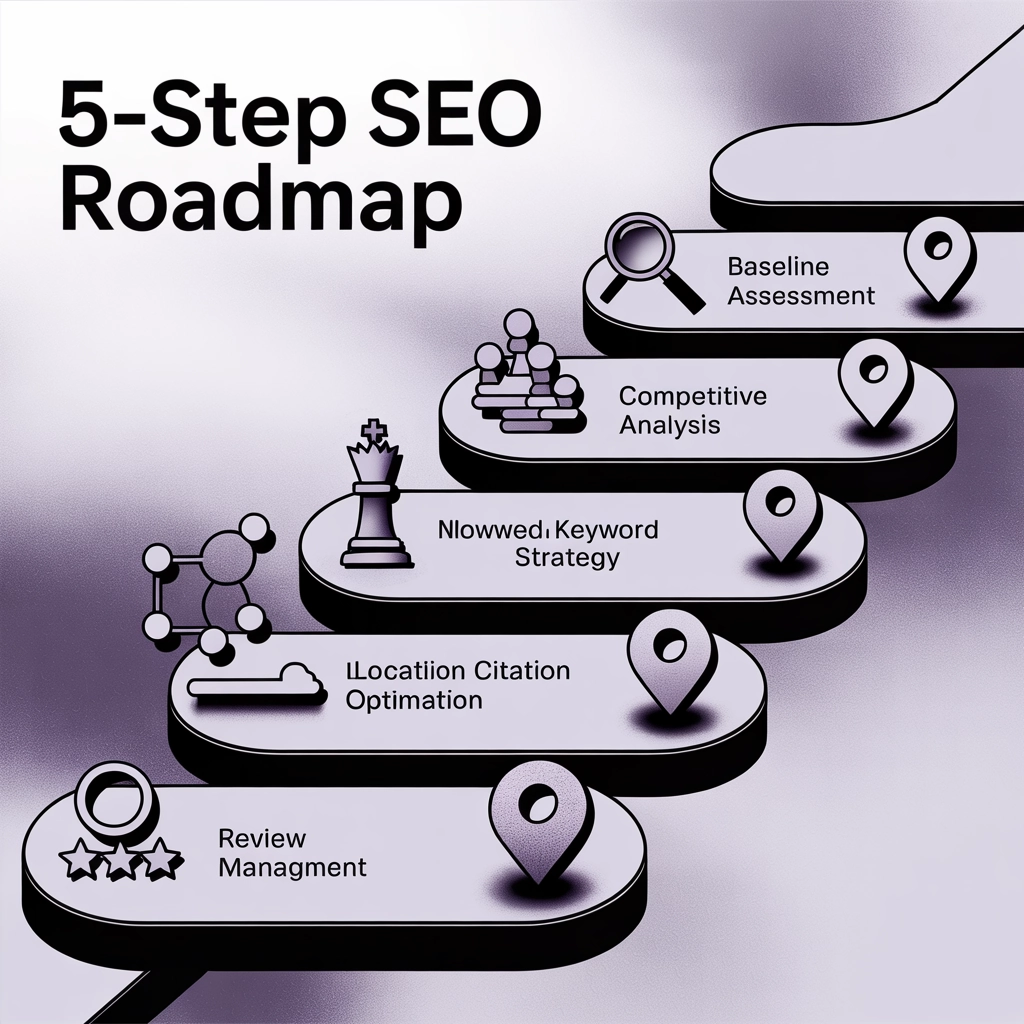
Step 4: Citation and Listing Optimization
Establish consistent business information:
- Use AI listing management to correct inconsistencies
- Prioritize citations on platforms most relevant to your industry
- Enhance listings with location-specific photos and details
- Set up monitoring for unauthorized listing changes
Step 5: Review Strategy Implementation
Leverage customer feedback:
- Implement an AI-powered review generation system
- Create templates for different types of review responses
- Establish protocols for addressing negative feedback
- Develop a system to incorporate review insights into business operations
Measuring Local SEO Success: Key Metrics to Track
When evaluating your AI-enhanced local SEO efforts, focus on these metrics:
- Search Visibility: Track ranking positions for location-specific keywords
- Google Business Profile Performance: Monitor views, clicks, calls, and direction requests
- Local Conversion Rate: Measure the percentage of local visitors who convert
- Review Growth and Sentiment: Track review volume, rating trends, and sentiment analysis
- Local Backlink Quality: Monitor location-relevant linking domains
- Citation Accuracy: Ensure business information consistency across platforms
Future of AI in Local SEO: What’s Coming Next
As AI continues to evolve, small businesses should watch for these emerging trends:
- Voice Search Optimization: AI will further refine voice-triggered local search results
- Visual Search: Image recognition will impact local discovery, especially for retail
- Predictive Intent: AI will anticipate customer needs based on behavior patterns
- Hyperlocal Personalization: Search results will become increasingly tailored to specific neighborhoods
- Automated Optimization: More aspects of local SEO will become automated through AI
Conclusion: Taking Action
The integration of AI into local SEO represents both a challenge and an opportunity for small businesses. Those who embrace these tools gain significant advantages in visibility, customer acquisition, and operational efficiency.
Begin by implementing one AI-powered local SEO tool from this guide, then gradually expand your strategy as you see results. Remember that while AI provides powerful insights and automation, local business success still depends on delivering exceptional value to your community.
For small businesses, local SEO enhanced by artificial intelligence isn’t just about ranking better—it’s about connecting more effectively with the customers right outside your door who are actively looking for what you offer.
Ready to transform your local SEO strategy with AI? Visit ASEB Consulting to learn how our team can help implement these advanced strategies for your business.