
Position Without Demand
A top ranking for a search almost nobody uses can create a good-looking report without creating meaningful visibility opportunity.

ASEB KEYWORD TRACKING · ORGANIC RANKS · DEMAND · OPPORTUNITY
ASEB Keyword Tracking is a separate product from ASEB Local Visibility. It monitors domain-level organic search performance and shows keyword-level rank, search volume, estimated traffic, CPC, landing URL, and score data. ASEB pairs that tracking with opportunity analysis so the report leads to a decision, not just a list.

Straight answer
ASEB Keyword Tracking monitors a domain's organic keyword footprint and the data behind individual rankings. The tool shows estimated organic traffic, total organic keywords, keyword position, search volume, estimated traffic, CPC, landing URL, and score data. ASEB then adds opportunity analysis so those measurements can influence what gets protected, improved, tested, replaced, or deprioritized.
Where keyword reports go wrong
Position alone does not tell the business whether a keyword has meaningful demand, commercial value, realistic competition, or the right search intent.
A top ranking for a search almost nobody uses can create a good-looking report without creating meaningful visibility opportunity.
A high-volume term can be valuable but still be a poor near-term investment when competition and current visibility make progress unrealistic.
Traffic potential is not the same as customer value. The wording and context of the search should connect to what the business actually sells and where it operates.
Watching a position move up or down is not a strategy. The useful question is whether to defend, improve, replace, test, monitor, or attack a better opportunity.
KISS keyword process
ASEB keeps keyword intelligence tied to decisions. Track the real visibility, add market and business context, compare the opportunity, choose the right action, execute where justified, and keep checking whether the market changed.
Monitor domain-level organic keyword positions and the landing URLs currently earning visibility for the searches that matter to the business.
Add search volume, estimated organic traffic, CPC, score data, and other available SEO metrics so each ranking has context.
Compare current targets against competitors, nearby opportunities, and alternative keyword phrasing that may offer a stronger path.
Decide which terms deserve protection, improvement, replacement, testing, monitoring, or aggressive attention based on the evidence.
Connect the recommendation to justified SEO, AEO, content, technical improvements, internal links, landing-page work, or other organic-search execution. Bring in Local Visibility only when local-market evidence is also needed.
Monitor rankings, demand, competition, and opportunity over time because useful targets can strengthen, weaken, or change as the market moves.
What the keyword tool measures
ASEB Keyword Tracking keeps the domain overview and the keyword-level evidence together. That makes it easier to see the size of the organic footprint, the searches creating visibility, and which landing pages are earning the rankings.
Review the domain or subfolder being analyzed together with estimated organic traffic and the total number of organic keywords being detected.
See how many organic keywords are associated with the domain or selected subfolder so ASEB can evaluate the size and direction of the search footprint.
Track the current organic position for each keyword instead of relying on occasional manual searches or a single screenshot in time.
Use search-volume data to understand whether a keyword has enough demand to justify protecting, improving, testing, or comparing it with other targets.
Estimate how much organic traffic the tracked keyword can be contributing so rank and demand can be viewed together rather than in isolation.
Use cost-per-click data as another market signal when evaluating whether the query has commercial value, while recognizing CPC is not a guarantee of lead quality.
See which landing page is earning visibility for each keyword so ASEB can connect search performance to the page that may need to be protected, improved, or replaced.
Pair the tracked metrics with ASEB's decision framework so keyword data can become a recommendation instead of another spreadsheet that nobody acts on.
Separate tools for separate questions
ASEB Keyword Tracking focuses on domain-level organic SEO performance: keywords, rankings, search volume, estimated traffic, CPC, landing URLs, and score data. ASEB Local Visibility focuses on local and Map Pack performance, local-market demand, difficulty, value, competition, and local recommendation logic. They can inform each other, but they are separate products with different jobs.
Real ASEB Keyword Tracking interface
These screenshots come from ASEB Keyword Tracking. The interface combines a domain overview with estimated organic traffic, organic keyword count, and a keyword table showing rank, volume, estimated traffic, CPC, ranking URL, and score data.


Connected by design
ASEB connects Keyword Tracking to SEO + AEO, content strategy, Local SEO, and ASEB Local Visibility when local-market evidence is also needed. The point is to keep the organic keyword tool distinct while still letting the data influence what gets optimized, created, protected, tested, or left alone.
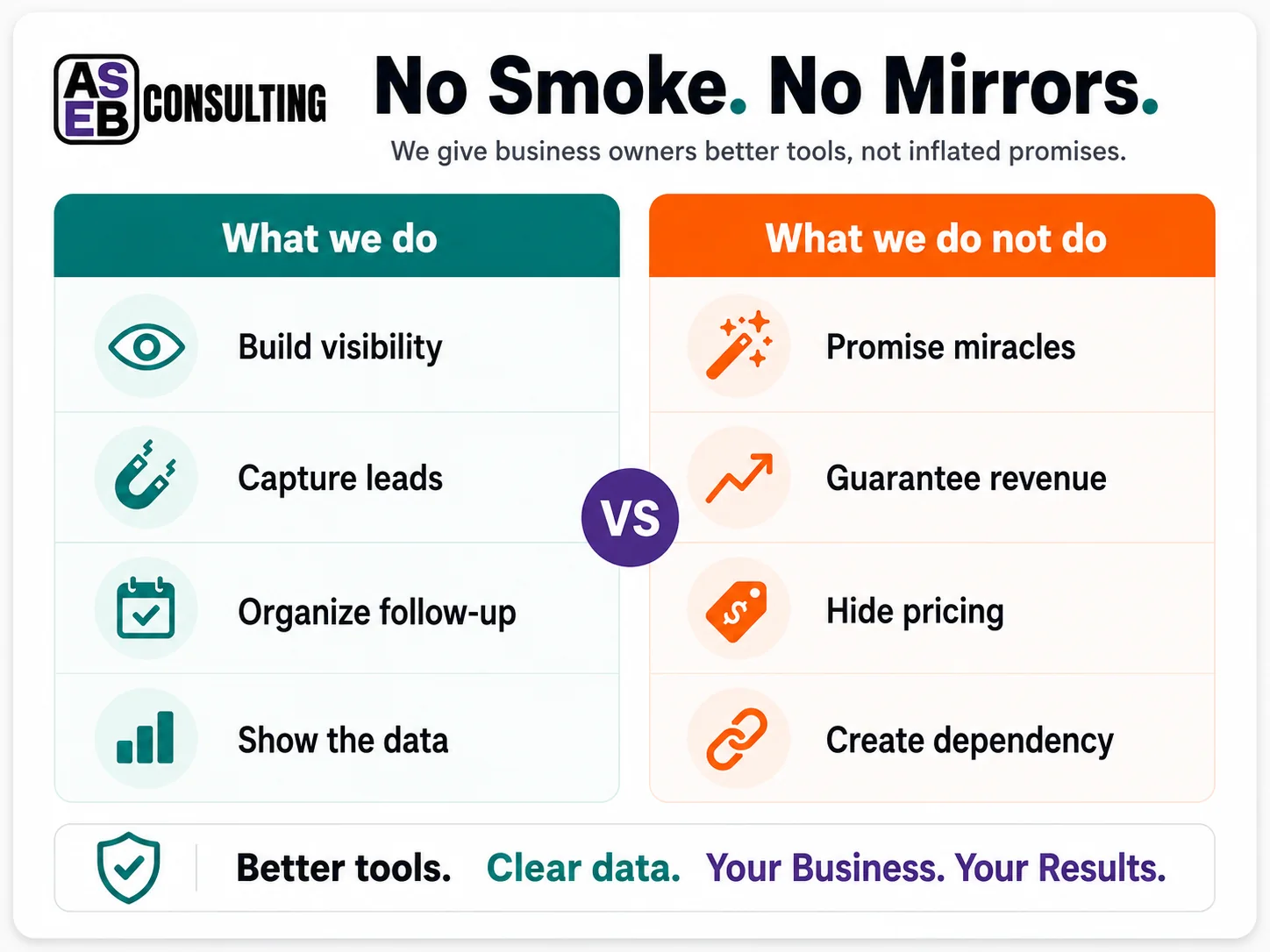
No smoke. No mirrors.
Keyword data is useful, but it is not perfect prophecy. Search-volume estimates, difficulty scores, ranking measurements, and competitor signals can vary by data source, location, device, timing, platform, and methodology. ASEB uses the available evidence to make better decisions. ASEB does not guarantee rankings, traffic, leads, sales, or revenue from any keyword.
Pricing context
ASEB does not present Keyword Tracking as the same product as Local Visibility or publish a separate standalone Keyword Tracking subscription on this page. When ongoing organic keyword monitoring is part of managed SEO/AEO work, it is scoped with that engagement. Current managed-package and standalone-audit pricing remain published on the Pricing page.
+ $349 setup. Everything in the $499 plan plus AI Visibility: see how ChatGPT, Gemini, Perplexity and AI search find and describe your business.
+ $299 setup. ASEB manages your website, and you get the Simplton toolkit in one login to get found locally and follow up on every lead.
+ $2,500 setup. All ASEB managed-service areas, including ad management for up to $5,000 per month in client-funded ad spend. Video shoots, photography, ad spend, and listed add-ons are separate.
Current published rates. See every ASEB price. The signed Statement of Work defines exact scope.
Keyword opportunity review
Tell ASEB about the business, primary services, markets, current SEO work, and the keywords or search themes you care about. We can review the current opportunity and identify where better tracking or prioritization may be useful.
No guaranteed rankings. No inflated keyword lists. The goal is to understand the search opportunity and recommend a practical next step.
We can connect a GHL keyword-opportunity review form here. Until then, use the direct contact options below.
Keyword intelligence questions
Straight answers about rank tracking, search demand, keyword difficulty, replacement targets, and how ASEB turns keyword data into recommendations.
Keyword tracking measures where a website appears for selected organic search queries over time. ASEB Keyword Tracking also shows domain-level estimated organic traffic, total organic keywords, keyword rank, search volume, estimated traffic, CPC, ranking URL, and score data so position can be evaluated with context.
Keyword opportunity analysis evaluates whether a search deserves marketing effort. ASEB looks at factors such as search demand, current visibility, difficulty, commercial value, competitive context, intent, and alternate targets to decide whether a keyword should be defended, improved, replaced, tested, monitored, or prioritized as a stronger opportunity.
High search demand can be useful, but it does not tell you whether the search matches the business, whether the competition is realistic, whether the current site can support the target, or whether another keyword offers a better path. ASEB treats demand as one signal rather than the whole strategy.
Keyword difficulty is an estimate of how competitive a search may be. Different data providers can calculate it differently, so ASEB treats difficulty as a directional decision signal rather than an absolute fact or guarantee of how hard a ranking will be to win.
Yes. ASEB can compare the tracked keyword data with related searches, search demand, business relevance, competition, and available opportunity signals to identify stronger alternatives instead of blindly chasing the original term.
Keyword intelligence helps determine which services, searches, and markets deserve attention. Local SEO is the execution layer that can improve Google Business Profile signals, website relevance, service and location pages, citations, reviews, content, internal links, and other factors supporting those opportunities.
No. ASEB does not guarantee search rankings, Map Pack positions, traffic, leads, sales, or revenue. Rankings and keyword data can change because of competition, platform updates, location, query interpretation, market behavior, and many other factors outside ASEB's control.
ASEB does not publish a separate standalone Keyword Tracking subscription price on this page. Keyword monitoring is scoped with the managed SEO/AEO work that needs it. ASEB publishes its current managed-package, one-time audit, and setup pricing on the Pricing page so the pricing relationship is visible before a sales conversation.
Measure the ranking, add the market context, compare the alternatives, and use the evidence to decide what the business should work on next.